


HireMee Signs MoU with Sona College of Technology for Learning Management System Services
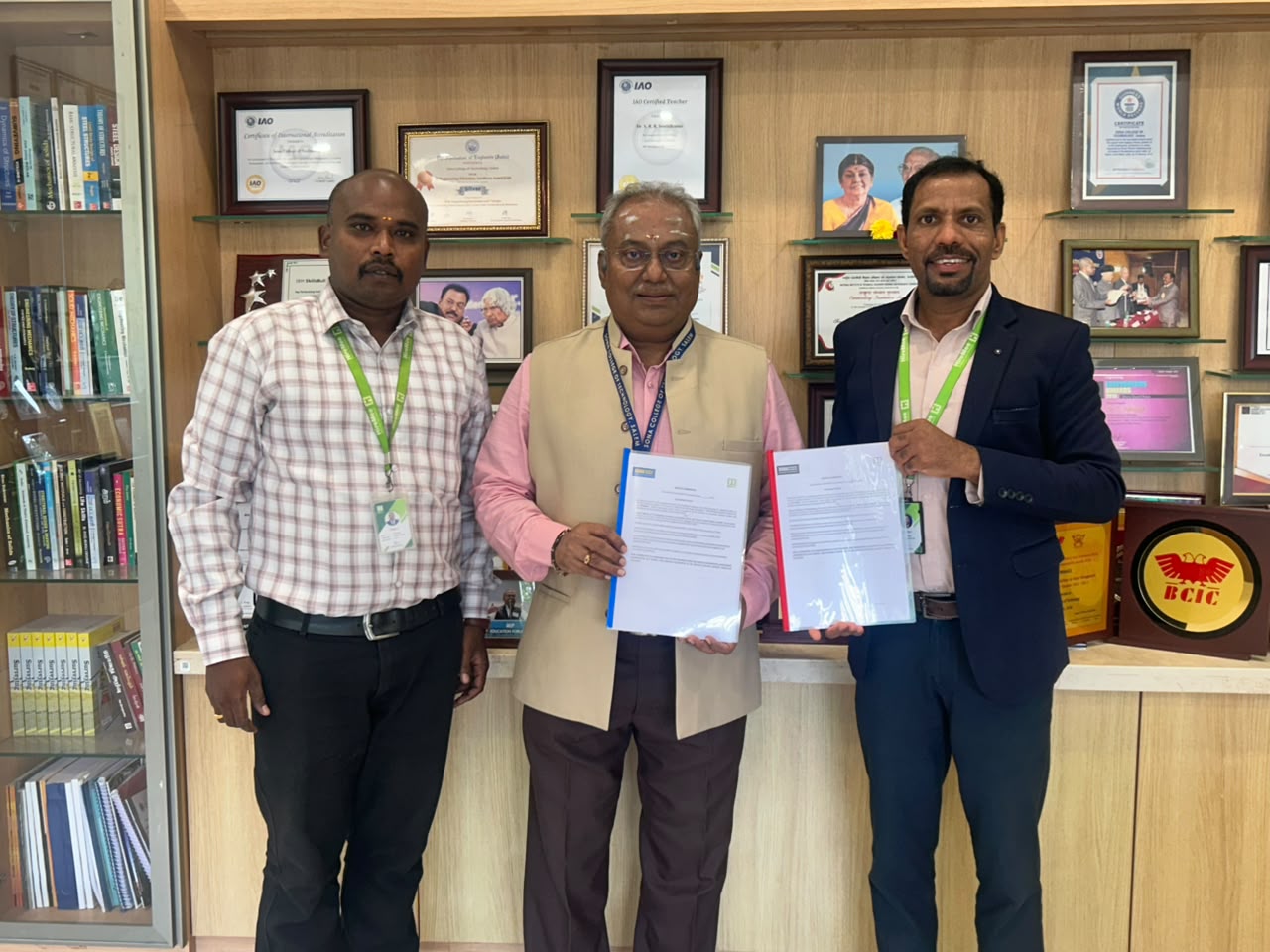
HireMee signed a Memorandum of Understanding with Sona College of Technology, Salem, on 6 October 2026 for its Learning Management System service. The collaboration creates an opportunity to support students with more organised learning resources and structured skill development alongside their classroom education.
The signing took place in the presence of Prof. Dr. S. R. R. Senthil Kumar, Principal of Sona College of Technology. Prabhu V and Girish Rai D represented HireMee and visited the institution for the MoU signing.
For students, the relevance extends into everyday academic life. A difficult concept may need another explanation before a laboratory session. A project review may require additional preparation. A workshop may spark an interest that deserves further exploration. A thoughtfully implemented learning management system can help connect these moments with suitable resources and academic guidance.
The MoU brings attention to an important part of college education: what happens between attending a class and confidently applying what was taught. Supporting that journey can help students make better use of their study time and approach new learning tasks with clearer direction.
Connecting classroom learning with independent study
Consider an engineering student preparing for a laboratory session the following morning. The classroom explanation made sense initially, but a few steps become less clear when the student begins working through the problem independently. Before attempting the practical task, those gaps need attention.
This is a familiar stage of learning. Understanding develops through returning to an idea, trying it in a different context, and asking more precise questions. Students benefit when they can find relevant material at the moment they need to work through a difficulty.
An organised digital learning environment can support that process. Where faculty provide suitable resources, the student could return to the topic, review the explanation, and arrive at the laboratory better prepared. The next conversation with the educator can then focus on the specific point that remains unclear.
The same principle applies across academic activities. Preparing for a seminar, revising a subject, and developing a project all involve work beyond scheduled teaching sessions. Linking that work with faculty guidance helps independent study remain connected to the institution’s educational objectives.
These examples illustrate potential uses of an LMS. The specific student programmes and implementation arrangements under the MoU have not been announced in the information provided. Their design will shape how the collaboration contributes to learning at Sona College of Technology.
HireMee’s LMS offering for educational institutions
HireMee’s Learning Management System, presented as VLearn in its published product information, supports the creation, delivery, and management of learning programmes. The platform brings courses and learning paths into a central repository and supports self paced learning, course management, progress tracking, reporting, and analytics.
Colleges are among the platform’s intended users. HireMee describes opportunities for institutions to organise courses, workshops, and seminars through the LMS. Its offering therefore addresses the administration of learning programmes as well as access to learning material.
For an institution, these capabilities can provide a foundation for organising supplementary learning around academic priorities. For students, the value lies in having a clearer route through the resources and activities selected for them. Relevant content and faculty involvement give that route its educational purpose. Each resource should answer a specific learning need.
The Sona College of Technology collaboration connects HireMee’s LMS service with an academic setting where students work across different subjects, practical activities, and learning needs. As the partnership develops, thoughtful programme design can help turn platform capabilities into useful support for those everyday requirements.
Giving revision a clearer starting point
Returning to the student preparing for tomorrow’s practical session, the first requirement is straightforward: finding the right resource. Searching through old messages or unrelated online explanations can consume time before meaningful revision begins. Clear organisation helps students start with material relevant to their course.
Faculty could structure available resources around a subject’s topics and learning objectives. A student revisiting an earlier concept would then have a recognisable starting point. Someone preparing for a new activity could identify the material that provides the necessary foundation.
This arrangement also supports consistency. When an educator directs a group to the same resource, students can prepare using a common reference and bring questions back to class. Additional explanations can build on that shared preparation rather than begin with uncertainty about what each learner has reviewed.
For students, the benefit is practical. Study time becomes easier to organise when the next task is clear. Instead of spending the first part of a session locating material, learners can concentrate on understanding the concept and identifying where they need further help.
Making room for different learning speeds
A classroom brings together students with different strengths and prior experiences. One may be comfortable with mathematical reasoning but need more practice explaining a technical decision. Another may communicate confidently while requiring additional time to understand a programming concept.
Self paced resources can support these differences within the institution’s academic schedule. Students can revisit available material, spend longer on an unfamiliar topic, or explore further learning where suitable resources are offered. This gives independent study a more purposeful role alongside classroom teaching.
Flexibility also matters when students balance lectures with laboratory work, commuting, and project deadlines. The opportunity to plan additional study around these responsibilities can make participation more manageable, provided students have the necessary access, devices, and connectivity.
The objective is to give learners useful ways to continue working towards academic expectations. Clear instructions and appropriately designed activities help students understand what to do next. Faculty guidance remains central, particularly when a learner needs an alternative explanation or help applying a concept accurately.
Helping faculty respond to learning needs
After the laboratory session, an educator may want to understand which concepts require further attention. Classroom participation provides one perspective, but some students are more comfortable asking questions than others. Learning activities can offer additional evidence to inform the next teaching decision.
HireMee’s published LMS capabilities include tracking and reporting on learner progress. Where suitable activities are configured, faculty could use this information to review participation and completion patterns. A missed activity can become a prompt to check whether a student needs academic help or assistance accessing the material.
The value comes from interpreting the information alongside other evidence. Completing a module does not establish mastery by itself. Conversations, practical work, and assessment responses help faculty understand how well students can apply what they have studied.
If a group needs more practice, an educator could introduce another worked example or revisit a topic during the next session. If one learner faces a specific difficulty, the response could be more focused. Digital learning information can support these decisions while keeping academic judgement with educators.
Extending the value of workshops and projects
Later in the semester, the same student might attend a workshop that introduces a useful technical approach. The session generates interest, but applying the idea requires more than remembering the presentation. Students need opportunities to revisit the material and try the approach themselves.
An LMS can help institutions organise that continuation. Where adopted for this purpose, preparatory material could introduce the subject before a workshop. Follow up resources and activities could then help participants work through what they encountered and prepare questions for further discussion.
For example, a workshop could be followed by a short practice task connected to an academic project. Students would have an opportunity to apply the idea and explain their choices. Faculty feedback could guide another attempt, helping learners recognise both their progress and the areas needing improvement.
This approach gives a learning event a place within a longer academic journey. Students can carry an introduction into practice and return to it when the subject becomes relevant again. The institution can organise those connections so that supplementary activities support its broader teaching objectives.
Building career preparation through regular practice
As students progress through college, academic preparation increasingly connects with decisions about further study and employment. A project presentation, for instance, asks learners to explain a problem, justify an approach, and respond to questions. Those activities provide useful occasions to practise communicating technical understanding.
An LMS could support supplementary learning around such academic milestones. With suitable content, institutions can organise preparatory activities that help students work towards specific needs over time. The emphasis should remain on relevant practice and feedback, so that students can recognise how an activity contributes to their development.
For the student approaching a project review, this might mean returning to resources that explain the underlying concept before preparing a presentation. Discussing the work with faculty can then help the learner describe the reasoning more accurately and identify questions that need further investigation.
Career preparation benefits from this continuity. Students can build confidence through repeated opportunities to demonstrate what they understand, rather than treating preparation as a single exercise near graduation. The collaboration offers an opportunity to organise learning support that contributes to that gradual development.
Supporting the people who organise student learning
Students benefit when the people supporting their education can coordinate learning activities clearly. Faculty need manageable ways to arrange material and communicate expectations. Academic coordinators need to understand how programmes are progressing and whether students can participate as intended.
A shared digital learning environment can help establish consistent practices. Departments could agree how courses are organised, where instructions appear, and how learners find assistance. Familiar processes make participation easier when students move between different subjects or supplementary programmes.
For academic leaders, reviewing participation alongside student and faculty feedback can help identify where support needs adjustment. A programme may need clearer instructions, different material, or more realistic scheduling. Addressing those issues connects administrative decisions with the experience of the learner.
Families also have an interest in how the institution supports student development. Explaining the educational purpose of additional learning programmes can give them a clearer understanding of the opportunities available. The most useful account focuses on what students are learning and how academic guidance supports their progress.
Building on Sona College of Technology’s academic mission
Sona College of Technology’s published mission emphasises developing graduates with the competence to contribute to the organisations they serve and to the wider community. Its academic offering includes engineering and other disciplines, providing a setting where learning support must respond to different educational requirements.
The HireMee collaboration can be understood within that focus. Organising digital learning around academic objectives gives the institution another means of supporting students as they move from understanding a subject to applying it. Appropriate resources and active faculty involvement will determine how effectively that support works.
The importance of implementation is also reflected in UNESCO’s 2023 Global Education Monitoring Report. It identifies access to technology, appropriate governance, and teacher preparation as conditions for educational technology to reach its potential. The educational purpose must guide how a platform is introduced and used.
For this collaboration, practical attention to student orientation, faculty support, and access will help connect the LMS service with college life. Learner feedback can reveal whether resources are easy to find, instructions are clear, and activities support the academic tasks students need to complete.
A positive step towards more connected learning
The MoU signed on 6 October 2026 provides a starting point for HireMee and Sona College of Technology to explore organised digital learning support. Its relevance lies in the opportunity to connect learning resources with the academic experiences that matter to students.
Return to the learner preparing for a practical session at the beginning of this story. Finding the relevant explanation, recognising a gap in understanding, and arriving ready to ask a focused question are achievable improvements in the learning process. The same habits can support later workshops and project work.
With thoughtful implementation, the collaboration can help make those moments of preparation more purposeful. For students, that means clearer opportunities to continue learning beyond class. For the institution, it means another way to support the effort that turns academic instruction into understanding and application.
Explore HireMee’s Learning Management System to learn how structured digital learning can support students and educational institutions.
To know more, email - girish.r@hiremee.co.in
Share on


